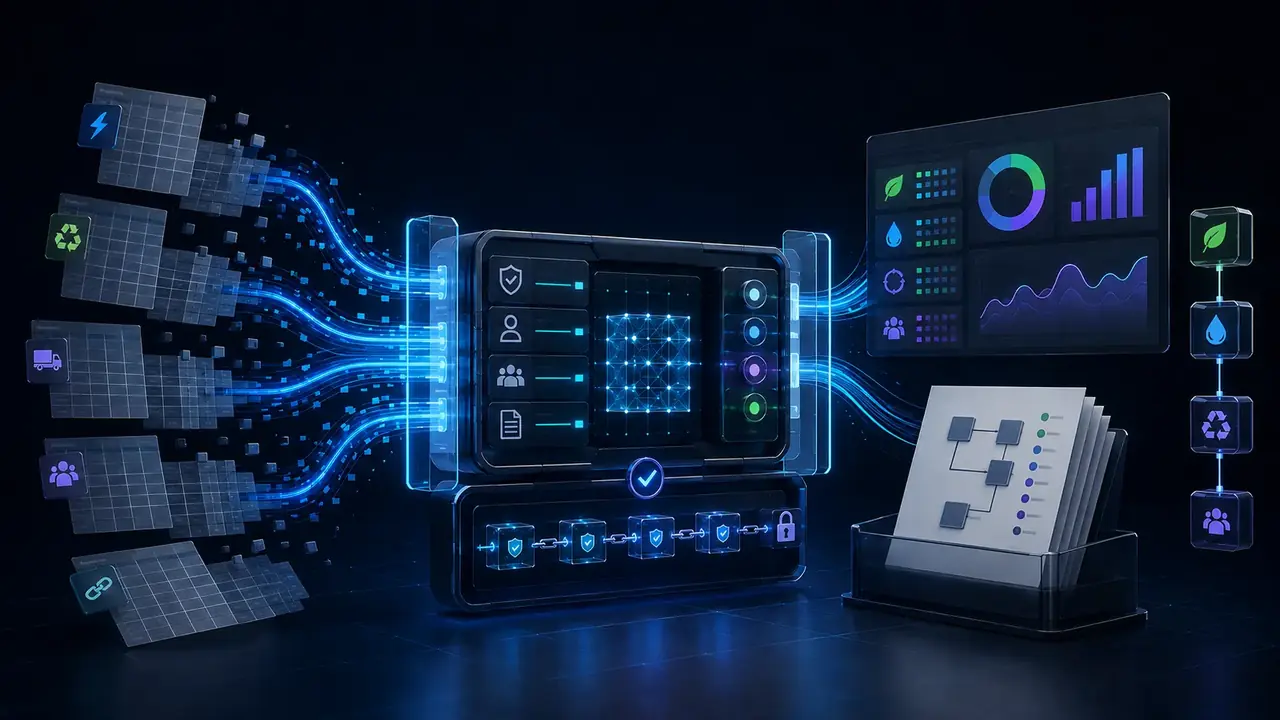
Many organisations begin ESG reporting with spreadsheets collected from finance, HR, fleet, procurement, facilities, and suppliers. The spreadsheet is not the real problem. The risk comes from unclear definitions, inconsistent periods, overwritten formulas, missing evidence, and no named owner for a reported number.
Odoo 19 includes an ESG application designed to bring operational information into sustainability reporting. Its usefulness still depends on the quality of the implementation and the reporting obligations that apply to the organisation.
1. Start with the reporting boundary
Before configuring a field or dashboard, define which legal entities, sites, activities, reporting periods, and categories are included. Confirm the framework or stakeholder requirement being addressed and obtain specialist advice where statutory reporting or external assurance applies.
- Document the organisational and operational boundary.
- Define reporting periods and cut-off rules.
- Record each metric, unit, source, owner, reviewer, and evidence requirement.
- Separate regulatory requirements from voluntary management indicators.
2. Build a controlled ESG data register
Create a register that links every reported metric to its source. Some information may come from accounting records, fleet activity, employee information, or other Odoo apps. Other information may require manual inputs or controlled imports from utilities and suppliers.
For every figure, can a reviewer identify who supplied it, the period it covers, the unit used, the calculation method, the evidence retained, and who approved it?
3. Treat emission factors as governed reference data
Odoo's carbon-footprint calculation follows the common structure of activity data multiplied by an emission factor. The result is only as reliable as those two inputs. Factor source, geography, year, version, unit conversion, and approval should therefore be documented.
Do not silently replace factors or formulas during a reporting cycle. Changes should be versioned, reviewed, and explained so historical reports remain reproducible.
4. Connect operational data carefully
Integration reduces re-entry, but it should not remove review. Map accounts, expense categories, fleet records, employee commuting inputs, and manual sources to the relevant ESG categories. Test samples from source transaction through calculation to report output.
- Reconcile totals back to the source system.
- Identify duplicates, exclusions, estimates, and missing periods.
- Apply role-based access to sensitive HR and supplier information.
- Keep supporting invoices, statements, logs, and approval records.
5. Design review and approval into the workflow
A practical control model separates preparation, review, and final approval where possible. Material adjustments should include an explanation and supporting evidence. Exceptions should remain visible until resolved rather than being corrected outside the system without a trace.
Audit readiness is not a dashboard style. It is the ability to reproduce a reported figure from its source, calculation, evidence, review, and approved disclosure.
6. Run a parallel reporting cycle
Before relying on the new process, run it alongside the existing reporting method for one complete cycle. Investigate differences and confirm that units, periods, factors, mappings, and boundaries are consistent. Obtain internal or external review appropriate to the organisation's obligations.
A sensible implementation sequence
- Discover: reporting obligations, stakeholders, boundaries, and current process.
- Design: data register, ownership, evidence, calculations, permissions, and approvals.
- Configure: sources, mappings, factors, workflows, and reporting views.
- Validate: reconcile samples and run a parallel reporting cycle.
- Operate: monitor exceptions, update controlled reference data, and review the process.
An ERP implementation does not itself certify compliance, the accuracy of emission factors, or the suitability of a disclosure. Reporting frameworks and assurance requirements must be confirmed with qualified legal, accounting, sustainability, and audit professionals.
Further reading: Odoo 19 ESG documentation.